
Buyer's Desk
MRI Site Planning Guide: RF Shielding, Cryogens, and Room Requirements
April 17, 2026 · 6 min · Medical Imaging Specialists
Practical considerations, risk points, and what to ask before you buy, service, move, or maintain imaging equipment.
Target keyword: MRI site planning requirements
Buying a refurbished MRI is only half the project. The other half — and the half that most first-time buyers underestimate — is getting the room ready to receive it. An MRI suite is not a standard medical room with a magnet dropped in. It is a carefully engineered environment that has to control radio frequencies, magnetic fields, vibration, temperature, humidity, and the occasional 1,500-liter cloud of helium gas.
Skip a step, and you can end up with ghosting on every scan, a magnet that can’t hold field, or a quench event that vents cryogens into the wrong space. This guide walks through the core MRI site planning requirements every buyer should understand before the magnet arrives on the truck.
Why MRI Site Planning Is Different
Unlike a CT scanner, which is mostly a matter of floor loading, power, and lead shielding, an MRI introduces three unique site challenges:
- A permanent, always-on magnetic field that extends well beyond the bore.
- Extreme sensitivity to outside RF interference, which can ruin image quality.
- A cryogenic cooling system holding liquid helium at roughly −452°F (−269°C).
Every decision about the room — location, construction, HVAC, power, and egress — flows from these three realities. Most OEMs publish a Pre-Installation Manual (PIM) or Site Planning Guide for each model (GE, Siemens, Philips, Hitachi, Toshiba/Canon), and those documents are the final word for your specific system. This guide is the plain-English version of what those manuals are telling you.
The RF Shielded Room (Faraday Cage)
MRI scanners detect extremely faint radio signals from hydrogen protons. Any outside RF — cell phones, two-way radios, pager systems, nearby broadcast towers, even a noisy dimmer switch — can land in that same frequency band and corrupt the image.
The solution is an RF shielded enclosure, essentially a room-inside-a-room built as a Faraday cage:
- Copper or galvanized steel panels line the walls, floor, and ceiling.
- A waveguide penetration panel allows cables, gases, and piping to enter without breaking the shield.
- An RF-shielded door with finger-stock contacts closes the cage each scan.
- A shielded viewing window between the scan and control rooms maintains line of sight without a hole in the shield.
Shielding is typically specified as attenuation at 64 MHz (for 1.5T) or 128 MHz (for 3T), with target attenuation commonly in the 80–100 dB range depending on the site’s ambient RF environment. An RF site survey before construction is strongly recommended, especially in urban areas or near hospitals with paging systems.
Magnetic Fringe Fields and the 5-Gauss Line
A superconducting MRI magnet’s field does not stop at the bore. It radiates outward in a three-dimensional “fringe field” that has to be mapped and respected during site planning.
Two lines matter most:
- The 5-gauss line (0.5 mT): The safety boundary. Pacemakers, implanted pumps, and other active medical devices can malfunction beyond this line. It must be contained inside a controlled-access area — typically the scan room itself, with signage and a locked door.
- The 1-gauss line: The equipment boundary. CRT monitors (rare today), some linear accelerators, electron microscopes, and certain PET/CT and nuclear medicine detectors can be disturbed here.
Passive or active magnetic shielding (steel plates in walls, ceiling, or floor, or shielded magnets with integrated steel) can compress the fringe field when the 5-gauss line would otherwise extend into a hallway, adjacent room, or floor above or below. Active-shielded magnets, standard on most modern refurbished systems, dramatically reduce fringe field compared to older unshielded magnets and often eliminate the need for room steel.
Cryogen Quench Pipe and Ventilation
Every superconducting MRI holds liquid helium to keep its magnet at roughly 4 Kelvin. In a quench — a rapid loss of superconductivity — that helium boils off and expands to roughly 750 times its liquid volume as gas.
Site planning has to handle two scenarios: normal boil-off and an emergency quench.
- Quench pipe: A dedicated vent pipe runs from the magnet to the building exterior. It must be sized per the OEM manual (typically 8–12 inches in diameter), routed with minimum bends, terminate away from windows, air intakes, pedestrian paths, and rooflines where people work, and be supported to handle the thermal shock of −269°C gas.
- Room ventilation: The scan room needs an oxygen monitor with audible and visual alarms, plus an HVAC system sized for the air changes per hour the OEM specifies. A minor helium leak in a sealed room can displace oxygen long before anyone notices.
- Emergency procedures: Clear signage, accessible magnet run-down unit (MRU / emergency stop), and trained staff who know the difference between “I smell something cold” and “evacuate now.”
Power, HVAC, and Structural Requirements
A refurbished 1.5T or 3T MRI typically needs:
- Dedicated 3-phase power (commonly 480V, though specs vary by OEM and chiller configuration).
- An isolation transformer sized to the system.
- A chilled water loop for the gradient coils and helium compressor, either tied into building chilled water or a dedicated chiller.
- Tight HVAC control — usually 65–75°F and 30–60% relative humidity, with low variation.
- Floor loading capable of supporting 10,000–20,000+ lbs depending on magnet model, plus the route to get it there (door widths, corridor turns, elevator capacity, knockout walls).
Vibration is the sneaky one. Nearby elevators, HVAC equipment, subway lines, or heavy traffic can induce image artifacts. A vibration survey before commitment is cheap insurance.
Typical MRI Suite Layout
A functional refurbished MRI suite usually includes:
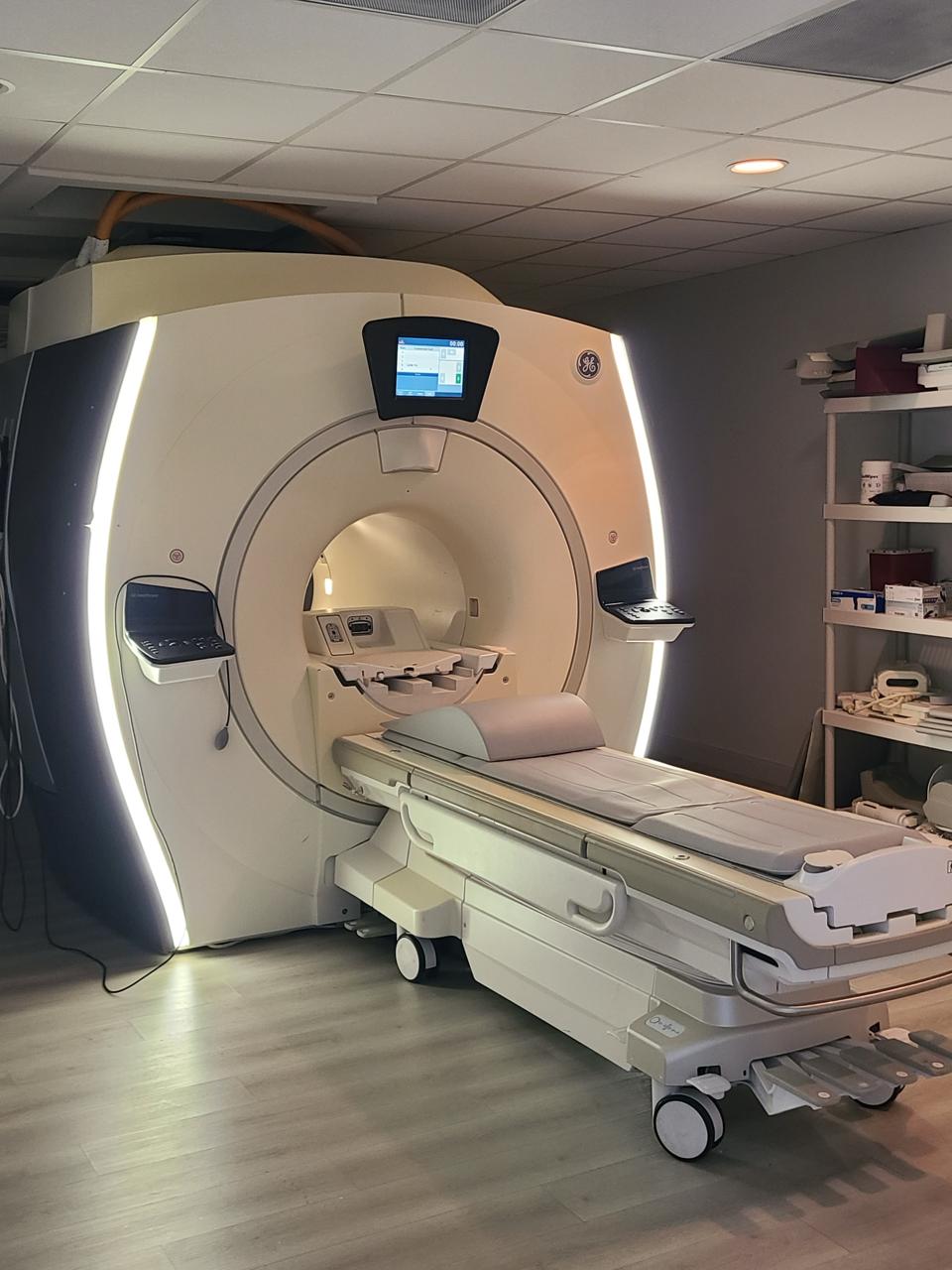
- Scan room — RF shielded, magnet, patient table, in-room coils.
- Control room — console, operator workstation, shielded window.
- Equipment room — gradient cabinets, RF amplifiers, helium compressor, system electronics; kept cool and serviceable.
- Patient prep / changing area — screening, gowning, ferrous check.
- Cryogen access path — route for helium fills without disrupting patient flow.
Keeping the equipment room close to the magnet (short cable runs) while keeping the control room comfortable and patient flow smooth is the layout puzzle every architect has to solve.
Timeline and Budget Realities
MRI site construction typically runs 12–20 weeks from permit to ready-for-magnet, with rigging, install, and OEM calibration adding another 2–4 weeks. Site costs for a new-build suite commonly run $250,000–$600,000+ before the scanner itself, depending on shielding class, structural work, and whether you’re retrofitting or building from scratch. Buyers replacing an existing MRI in a pre-shielded room often save substantially — another reason used imaging real estate has value.
Build your timeline backwards from the first-patient date, and don’t let the scanner arrive before the room is genuinely ready. A magnet sitting on a loading dock is expensive.
Partner With Medical Imaging Specialists
MRI site planning rewards experience. At Medical Imaging Specialists, we’ve guided hospitals, imaging centers, and outpatient clinics across the US, Caribbean, and LATAM through refurbished MRI projects from first floor plan to first patient scan. We’ll review your site, coordinate with your architect and RF shielding vendor, pull the right OEM pre-installation documents, and manage de-installation, rigging, installation, and service — so your suite is ready the day the magnet arrives.
Planning a refurbished 1.5T or 3T MRI install? Contact Medical Imaging Specialists to talk through your site, timeline, and equipment options with engineers who’ve done this before.
Related Reading
Talk Through Your Next Imaging Project
If you are evaluating refurbished imaging equipment, planning a service strategy, or trying to keep an aging scanner productive, Medical Imaging Specialists can help. Contact MIS through the website and tell us what system you are working with.
Need help with this exact problem?
Send the modality, site location, timeline, and any system details. MIS will route the request by intent.
Related resources
Buyer's Desk
What Affects Used Medical Imaging Equipment Resale Value?
Used imaging equipment resale value depends on model, condition, records, accessories, demand, supportability, and removal complexity.
Buyer's Desk
What Questions Should You Ask Before Buying a Used MRI?
Before buying a used MRI, ask these equipment, service, site, logistics, parts, and quote questions to avoid expensive surprises.
Buyer's Desk
What to Look for When Buying a Used CT Scanner
Buying a used CT scanner? Check tube life, service history, parts support, site fit, software, installation scope, and post-sale service.